
How are 3D crystal photos made?
3D crystal photos are made by subsurface laser engraving: millions of tiny points fired inside solid K9 crystal. Each step, from your photo to the LED base.
Written at Shop K33, Pacific Werribee ·
Short answer: 3D crystal photos are made with subsurface laser engraving. Your photo is turned into a 3D map of points, then a laser fires millions of tiny pulses inside a solid block of optical K9 crystal. Each pulse makes a hair-thin fracture that catches light, so the image appears to float inside the glass. The outside surface is never touched.
- Check the photo for focus and lighting
- Convert it into a 3D point cloud
- Laser-engrave the points inside the crystal
- Clean and inspect every piece by hand
- Light it from below on an LED base
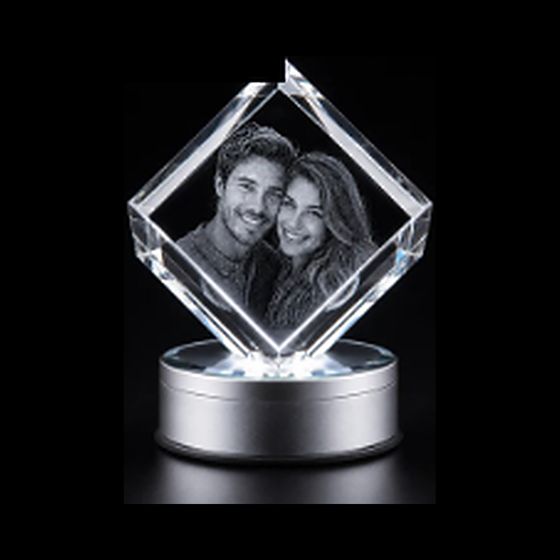
People assume the picture is printed on the crystal, or etched into the back of it. Neither is true, and the difference is the whole point.
The photograph comes first
Before anything is cut, we look at the file. Focus, lighting, resolution, and how much of the frame the subject occupies. If the eyes are soft, the engraving will be soft, and no amount of laser work fixes that. This is the stage where we tell people honestly to find another photo.
Turning a flat image into depth
A photograph has no depth information, so one has to be built. The image is converted into a three-dimensional point cloud: a map of millions of coordinates, each one a location inside the block where a point of light should exist. Areas that need to read as bright get denser clusters; shadows get almost none.
Inside the crystal
The block is optical-grade K9 crystal, chosen because it is clear enough to focus a laser through without distorting it. The laser fires at a precise depth and creates a fracture roughly the width of a human hair. It does this millions of times, working through the volume of the block, and never touches the outer surface.
That is why the image has parallax. Move your head and the subject shifts relative to the edges of the block, because it genuinely occupies space rather than sitting on a plane.
Finishing by hand
Out of the machine, a crystal is cloudy with residue and dust. Every piece is cleaned, inspected under light, and checked for internal flaws before it goes anywhere near a gift box. This is the part that cannot be automated and the part customers notice most.
The light base
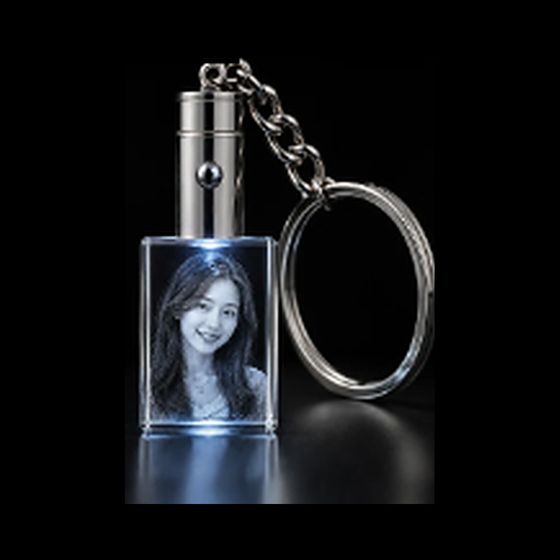
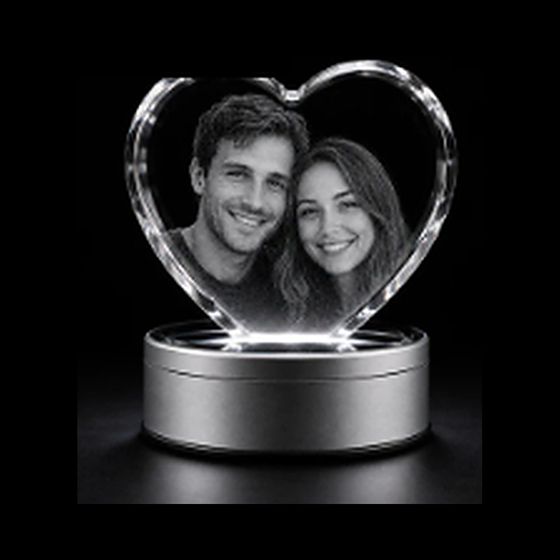
Unlit, a 3D engraving looks like a faint ghost. Lit from beneath, every fracture point scatters light and the image lifts out of the glass. That is why an LED base is included free with every crystal except the keychains, which carry their own light in the cap.
Made here, not shipped in
All of it happens at Shop K33, Pacific Werribee. If you want to see the machines, come in and ask. The ordering process is here, and the studio address is on our contact page.
Wondering how this compares with engraving a photo on a glass? We cover that in glass vs 3D crystal.
Common questions
Is the photo printed or glued inside the crystal?
Neither. The image is made of millions of tiny laser fractures inside solid crystal. Nothing is printed, glued or layered, and the outer surface stays smooth.
Can you 3D engrave crystal at home?
Not with a normal hobby laser. Diode and CO2 engravers only mark the surface. Engraving inside crystal needs a specialist subsurface laser engraving machine and optical-grade crystal blanks, which is why it is done in a studio.
Will a 3D crystal photo fade over time?
No. There is no ink or dye to fade. The image is physical fractures inside the crystal, so it lasts as long as the crystal does. Keep it out of hot cars and clean it with a soft cloth.
How long does a 3D crystal photo take?
Most made-to-order crystals are ready in about 5 to 7 business days, plus postage if it is being sent. Busy gift seasons like Christmas book out earlier, so order ahead.
Ready to turn your photo into crystal?
Send us the photo and we will tell you honestly which shape suits it. Or come to the studio at Pacific Werribee and hold one first.